

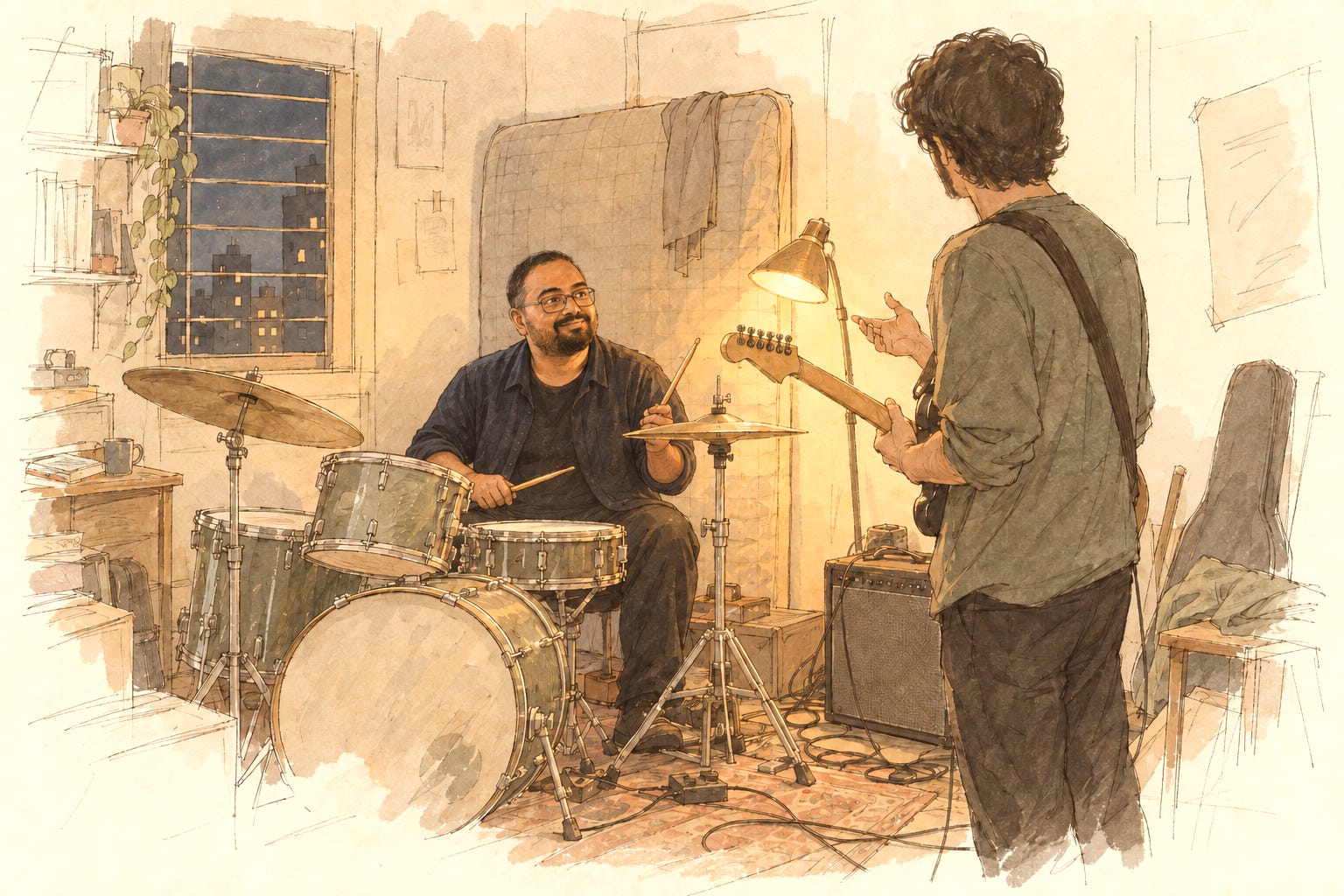
The band room
I remember in a practice pad I was meeting a guitarist. He was telling me that if you want to be great at something, a good guitarist shows off, knows how to play every chord, and tries to use all the different chords.
Then, when we were making a song for my band Old School, Pallab Mahmud was coming up with a guitar solo, and I asked him, “Doesn’t it feel too empty?” He said, “Well, that is by design.” That’s when he told me this: “You know what makes a good guitarist from a great guitarist? A great guitarist knows what not to play. A good guitarist knows what to play in the show-off part. The great guitarist chooses what not to play.”
Pallab Bhaiya is a Senior Software Engineer at Microsoft now.
When he shared this with me, it stuck in my head. I’ve been playing tabla, the percussion, for over two decades now, and whenever I have gotten the chance, I have always tried to make my beats, my solos, as busy as possible. But here was this guy having the time of his life, deliberately choosing not to play something.
I respect Pallab Bhaiya from the bottom of my heart, and that respect, with his statement, stuck with me!
Finding the beat
When I was building my beats for the song in tabla, I said to myself, “Do I show off, or do I find the beat?”
That led me to take the beat from Massive Attack’s “Teardrop”. I kind of took that to heart and listened to that track a lot, and that produced the beat for my best-known song, “Aaj Raate Kono Rupkotha Nei.”
Moktadir Dewan Shanto Bhaiya played guitar in our band as well. Today he is a beatboxer who goes by Beat Baksho. He used to say this: “Shadman, it literally feels like your tabla talks, like it spits out lyrics.” I think that tabla talking came from these moments, when I learned from Pallab Bhaiya that great artists know what not to play. Huge credit to him for that!
Thelonious Monk’s version of the same advice survives in a list Steve Lacy wrote out by hand:
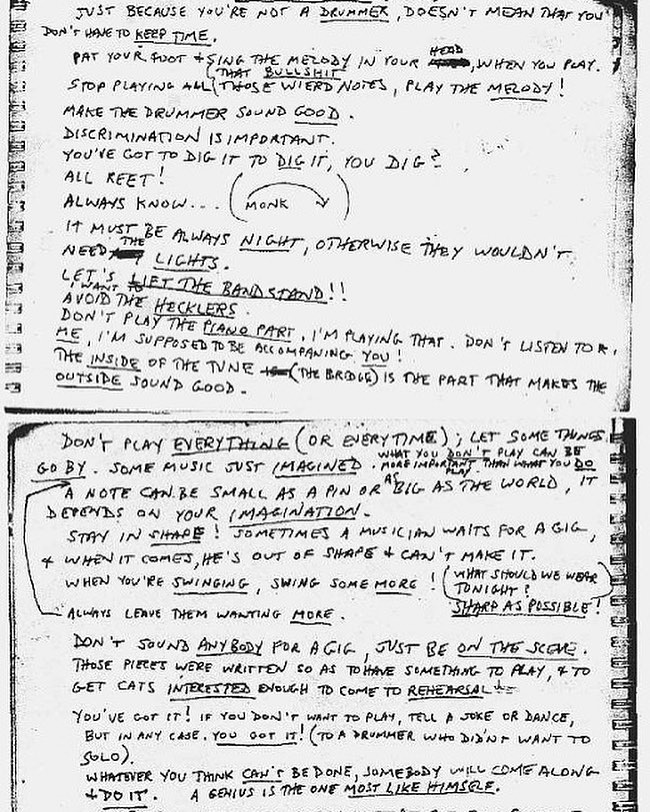
“Don’t play everything (or everytime); let some things go by. Some music just imagined. What you don’t play can be more important than what you do.”
The more I shipped
Now, fast forward in the product world. Examples of turning into a feature factory are so many. Oh my God, I can’t even tell you. Throughout my life, it has always been about “ship more, ship more, ship more.”
Wherever I have gone, whenever I was young, I felt like the more I ship, the more I show my true worth.
In November 2015, I designed Bluebox, an app for Grameenphone’s retailers. It had one solid journey, a single purchase journey, but then we started adding journeys after journeys into it, all through 2016. I thought that this should be their learning platform. Retailers should be able to raise complaints to Grameenphone using the same Bluebox app. They should be able to order more inventory through this app.
I remember 2015, 2016, 2017 in Bangladesh. The story was all about how WeChat is becoming “the thing”, so in Bangladesh, to some extent, everybody was in this race of building a super app. You would do everything from one place.
Look at these interfaces: pretty much all of them look the same now. Look at Eastern Bank Limited’s banking app, the bKash app, and the MyGP app. The three of them do three different things: a solid retail banking app, a mobile financial services app, and a telco self-service. The homepage looks exactly the same. Why? Because everybody wants to have everything.
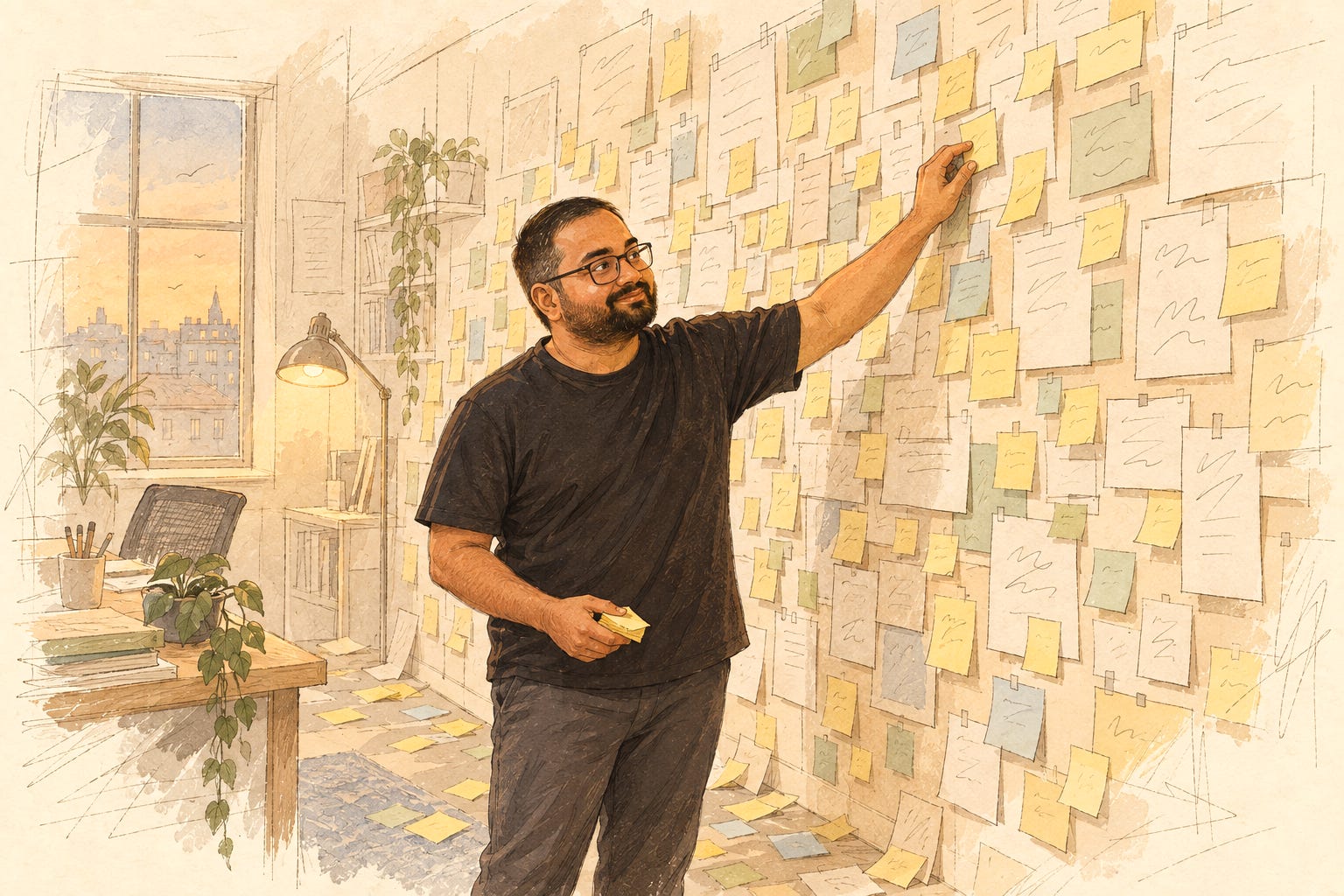
I believe I brought that baggage with me as well, where my roadmap was always filled with features after features after features after features.
A typical trap of a feature factory is that everyone gets into the mindset of, “Okay, let’s ship and ship. The more we ship, the more value we give to our users.” Is it so true? Short answer: no. It’s about a curated experience.
Two no’s at Grameenphone
In 2017 I was at Grameenphone building Hello Messenger. The beta carried more than 150,000 messages. Our research had mapped the category as already taken: Messenger and WhatsApp for friends, Viber for family, IMO for video.
I was the one who took the hard call, the hard decision, of not shipping Hello Messenger as a standalone product.
Hello Messenger’s kill call came from us, from the Hello team: two engineers, my boss, and me. The reason we made the call is the huge build cost. The work we would have to do to ship it as a solid product outweighed the payoff. Although we had the full go-ahead from the Grameenphone management team, we would be fighting a battle that is very uphill, and it didn’t make sense.
Around late October 2017, I went to the team and said, “Guys, thank you very much. Amazing beta performance. This is truly working out really well. We have a solid validated use case, but given the whole scenario, I feel that we should take this learning and implement it in one of our sister products, which is Bioscope. Let’s scope that.” One engineer started scoping it for Bioscope. I asked the other to scope it for the chat in myGP.
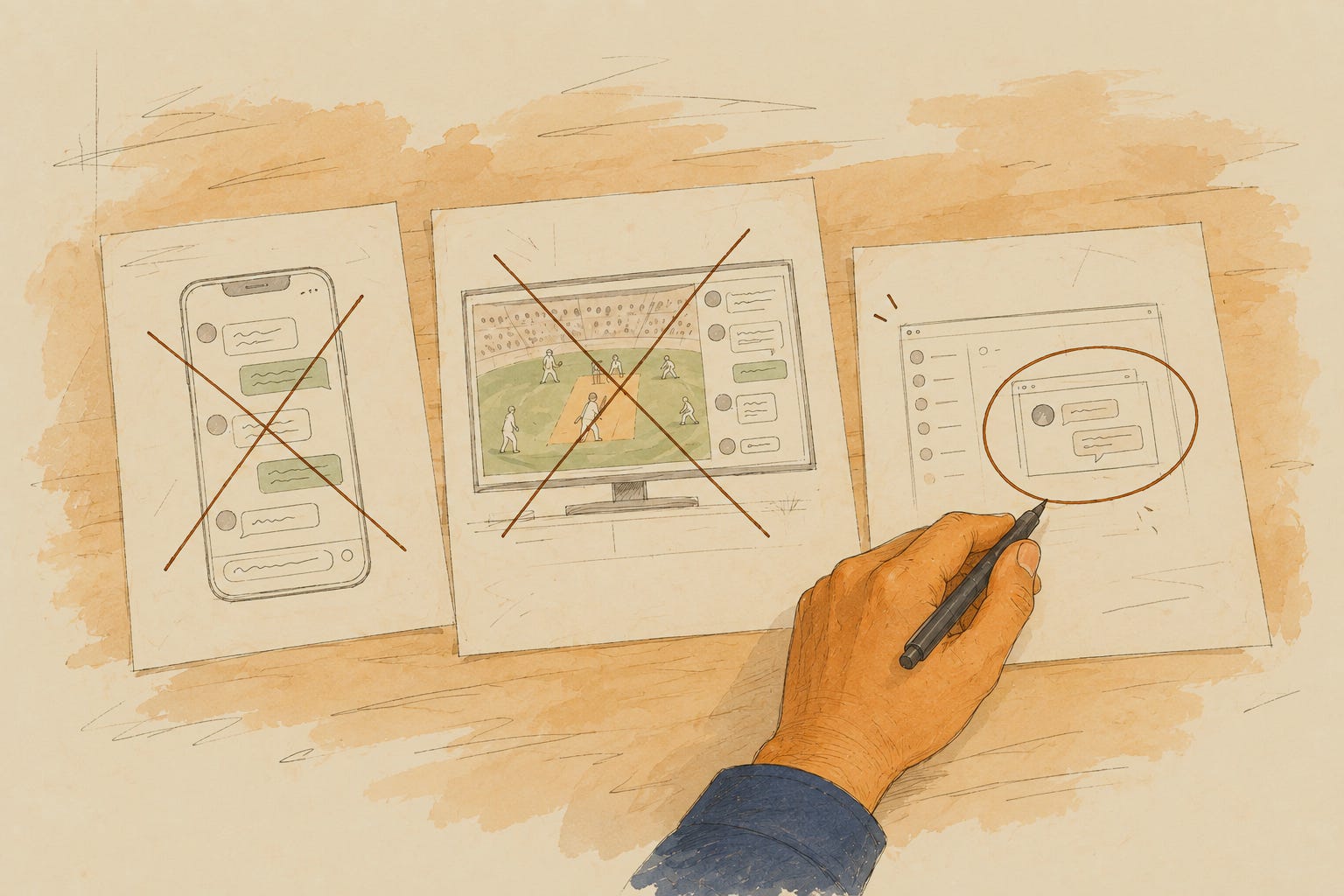
That was the first no. There was a second one.
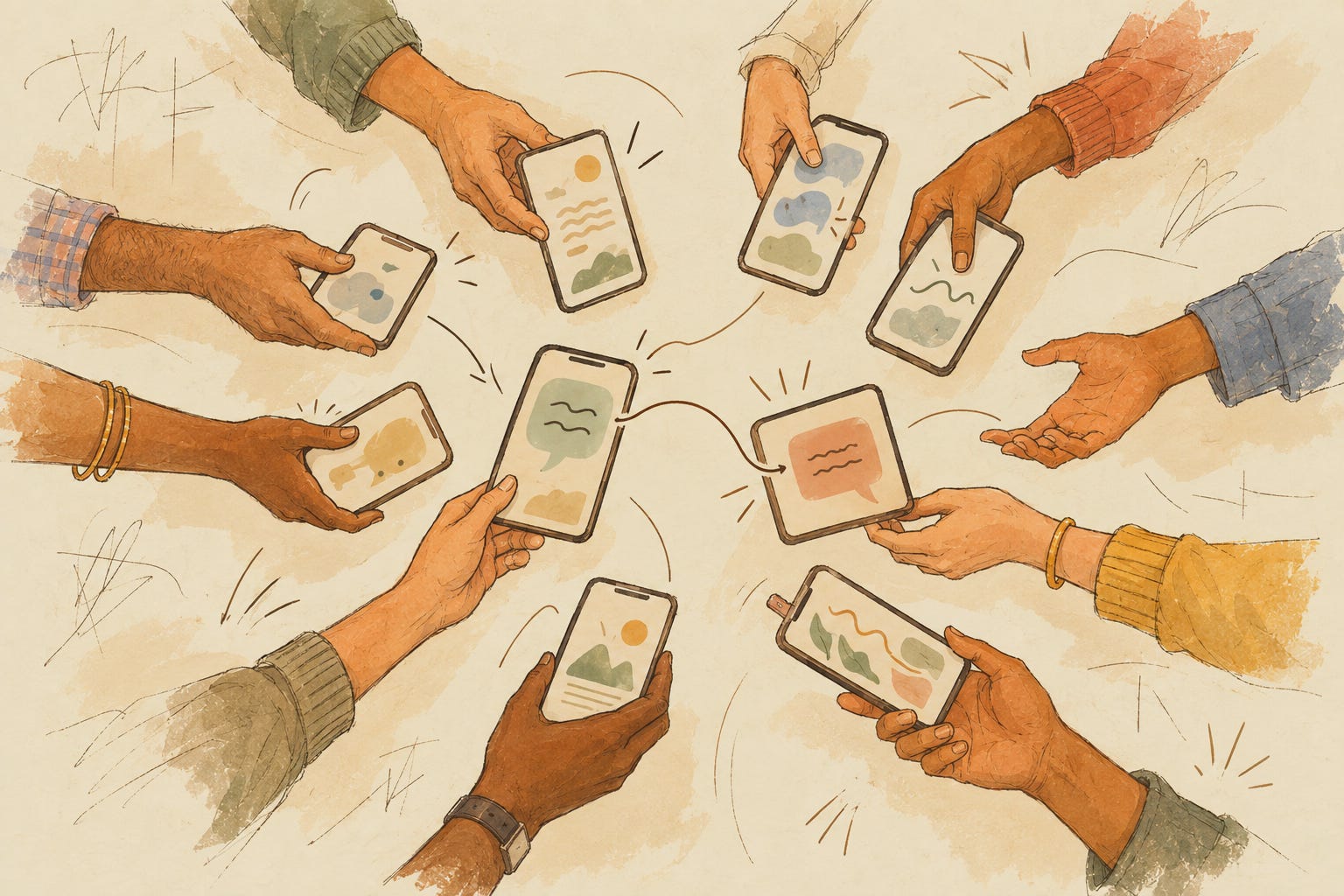
The live chat during broadcasts use case was validated, but we did not ship it because it didn’t make sense.
The reason broadcast chat did not make sense is because it is a highly engaging feature, but then again, it is highly short-lived as well. Just think about it: there is something interesting going on, and then you have to be present in the environment that you are comfortable with. You wouldn’t open up yet another messaging app to go in and start chatting over there, right?
It would make sense if the original plan was to bake this into Bioscope, for example, because that’s where the game was happening.
We embedded the messaging capability into the myGP telco app, and it was used for offering customer care. We rather shipped customer care chat with themes and allowed community users to solve one another’s problems.
The other side of the world
When YouTube’s live chat appeared, honestly, it felt like a great validation. I took it as a Medal of Honor, and this has happened two times in my life.
The first time was at Beshto, a startup I worked at. I was very inspired by BuzzFeed: below every BuzzFeed article, they would have these segmented reactions, this many LOLs, this many ha ha’s, this many wows. That led me to introduce reactions in Beshto back in 2012. We had six different reactions in Bengali. We didn’t have emojis for it, just reactions.
When Facebook shipped reactions, it felt to me like, “Oh wow, what I thought of, someone on the other side of the world is actually thinking along the same lines. These guys are highly educated people, and I’m someone who barely passed the university, now working in a startup. Our thoughts match. Oh wow, that’s amazing!”
No, or not now
Des Traynor wrote on the Intercom blog in 2013: “If you’re building a product, you have to be great at saying no. Not ‘maybe’ or ‘later’. The only word is no.” The first reason to say yes on his list is “engagement is off the charts”, and his reply is “does that mean your product is better?”
Earlier, 37signals put a different no into Getting Real. Every feature request, theirs included, starts with a no:
“We listen but don’t act. The initial response is ‘not now.’”
Hello got both.
The answer was a no on messaging. It was a not now on Bioscope because Bioscope itself was not set up as a very strong product.
Steve Jobs told Fortune in 2008: “I’m actually as proud of many of the things we haven’t done as the things we have done.” In the same interview he described years of pressure to build a PDA: “[s]o we decided not to get into it. If we had gotten into it, we wouldn’t have had the resources to do the iPod.”
Curating
Now I’m realizing, as a principal PM, it is about curating. It is about that opinion.
Reading Continuous Discovery Habits by Teresa Torres, and the articles she keeps writing on Product Talk, solidified some of my foundations: my learning from HCI, learning from Uppsala University, and my previous few no calls, like deciding not to ship.
Then I came to my current job. The requests coming left, right, front and center were always about, “Okay, this is not working out. This feature is the answer. That is not working out. That feature is the answer.” On our search algorithm, on the recommendations that we give to students, everything became, “Okay, the answer to this is a new feature or a new logic,” and then I started putting a stop to it.
The more I started putting a stop to it, the more it started making sense that the fundamental experience is really realizing what not to ship. The fundamental experience is really asking ourselves the why. The fundamental experience is, before deciding what new to build, deciding on what is there in the inventory that does not make sense anymore.
Our job is not to become a feature factory.
The tasting menu
We decided not to ship a standalone product because it is all about curated experiences. When something is going on, your mental model reaches for the things you are used to. A standalone app asks you to build a habit: whenever something interesting happens, you go there. Weigh the cost of building that habit against having the technology plugged in by default. You have a problem, you reach out to Grameenphone, and the community solves it for you. A match is on, you are streaming it in Bioscope, and the chat is right there in Bioscope, which makes a lot more sense than opening up a separate chat.
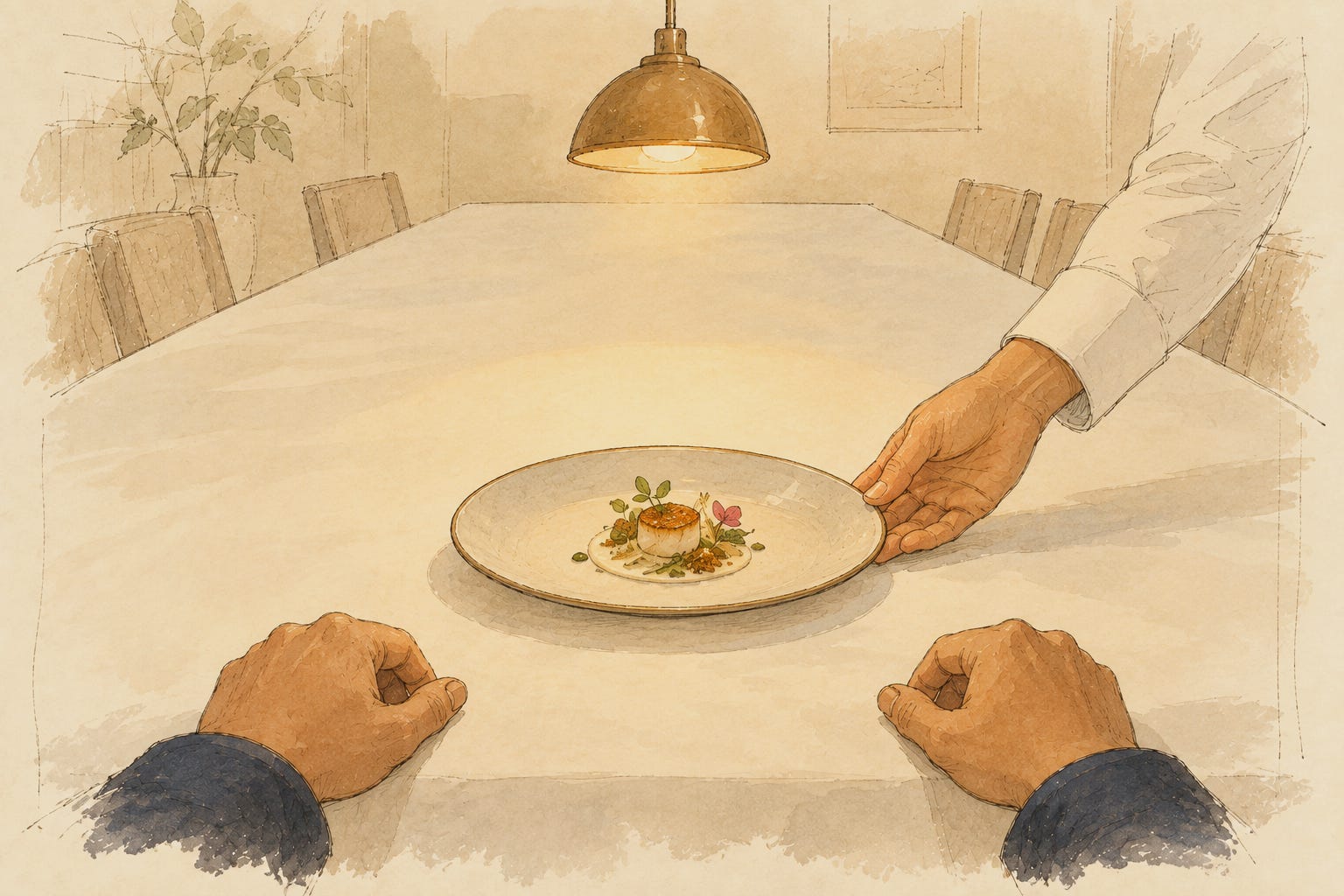
It’s the same analogy. You don’t book a Michelin-star tasting menu to be served with a buffet-style dish. No, you go there for the experience, where one dish after another comes in and it is meticulously designed. They take away your agency, yet they provide you with a great experience. You trust the chef and the people in the restaurant to curate it for you. You do not go there to read a large menu and pick your best dish.
Knowing what to leave off the menu is what separates the good from the great.
That is exactly the philosophy that I follow now. I run my own ideas through Crucible, a council of personas I set up to argue with me. When I put my own 78-hour growth plan in front of it, the council priced the plan as negative. The work that actually mattered was a 10 to 14 hour one-off fix. I said no to my own plan and took the small one.
That is where Hello ended up: customer care chat with themes, where community users solve one another’s problems.

☕ Thanks for reading Product Field Notes!
If this one made you look again at what is sitting on your own roadmap, hit subscribe and the next post lands in your inbox. And if you know a PM who is shipping everything on the list, send it their way.